
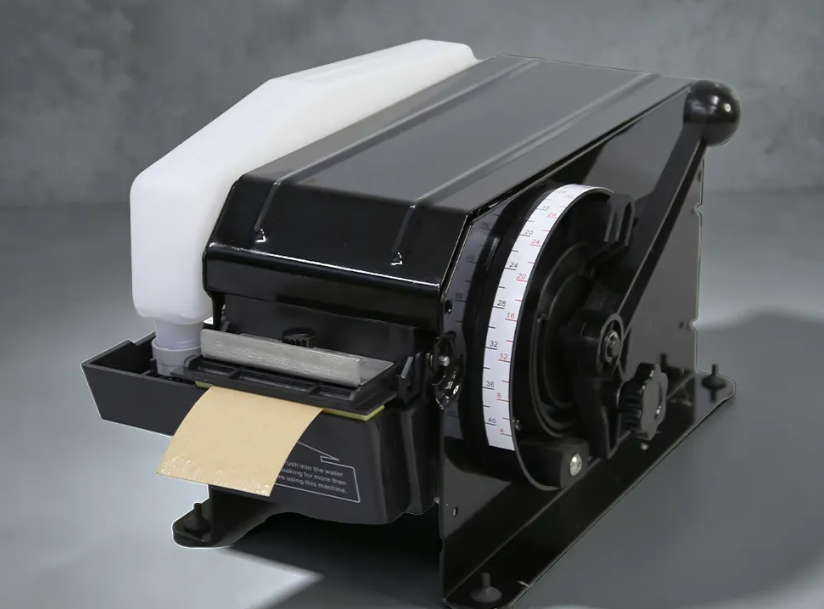
An electric tape machine changes the character of a packing station in ways that are not obvious from a specification sheet. The operator stops measuring, stops pulling, and stops making a small judgment call on every carton. In exchange, the station acquires a power requirement, a water tank to manage, and a maintenance routine that has to actually happen.
Whether that trade is worth making depends on a handful of factors that are easy to assess in advance and expensive to discover afterward. This article works through them, drawing on practical experience with water-activated paper tape systems.
What the machine actually automates
On a water-activated system, an electric tape machine feeds gummed kraft paper tape, wets the starch-based adhesive, cuts a preset length, and presents the strip for application. On button-triggered models, the operator initiates each cycle; on sensor-equipped units, tape dispenses when a hand or carton passes the sensor.
The critical step is wetting. The adhesive must be activated by water to bond into the surface fibers of corrugated board. Once cured, the seal cannot be opened and reclosed without visible damage to the carton — a security property that explains much of the demand in electronics, pharmaceuticals, and regulated goods. It also explains why the machine’s consistency matters more than its speed: a fast unit that wets unevenly produces failures, and the speed counts for nothing.
The volume question, and the one buyers miss
Two numbers determine whether an electric tape machine earns its cost, and most buyers check only the first.
Daily carton volume is the obvious one. Operations sealing under roughly 100 cartons a day rarely recover the investment; a manual lever dispenser such as the NT-800 handles that pace without power or installation. Once a team is consistently sealing several hundred cartons daily, preset lengths and a heated tank begin removing measurable time from every box.
Peak-hour throughput is the one that gets overlooked. A station that runs comfortably most of the week but hits a hard ceiling during dispatch windows benefits from electric operation even at modest weekly volume, because the constraint is the peak, not the average. Buying purely on average volume can leave a team under-equipped precisely when it matters.
The savings that never appear on a quote
Tape consumption is among the least-tracked costs on a packing line. Operators using hand-held guns tend to over-pull for security. An electric machine with adjustable cut lengths — commonly spanning roughly 15 cm to 210 cm — standardizes usage per carton size. On a line sealing several hundred cartons daily, trimming even a modest excess from each strip compounds into a measurable annual reduction.
Units with a tape length detector go further, measuring a carton and calculating the optimal strip — useful for operations with mixed box sizes rather than uniform order profiles. For uniform cartons, preset buttons cover the requirement at lower cost, a distinction worth settling before paying for capability the workflow will not use.
Power, placement, and noise
Electric operation introduces practical considerations that manual dispensers avoid. Station layout matters: a machine at the wrong height or angle will underperform its rated output regardless of specification, and sensor-equipped units are particularly sensitive to placement. Noise also matters for a unit running continuously through a shift — models operating below 70 dB are easier to place on a shared packing floor without disrupting the workspace. Dispensing speeds around 60 m/min are achievable on some sensor units, though real output depends on tape width, carton size, and operator rhythm.
Maintenance is concentrated, not eliminated
Electric systems do not remove maintenance; they focus it on fewer, more critical points. The moistening brush is decisive. Dried starch hardens on the brush, wetting becomes uneven, and adhesion drops — typically showing up as tape lifting at carton corners the next morning, after the shipment may have gone.
An end-of-shift routine prevents nearly all of it: drain and rinse the water tank, wipe the brush, and check the blade weekly. Heated tanks with roughly 1-liter capacity support steady activation through a shift, and filtered water reduces mineral buildup where supply is hard. Confirm blades are easy to replace and spares are stocked; a machine idled for a week over a backordered blade costs far more than the blade.
Tape compatibility deserves a full-roll test
A machine is only as good as the tape paired with it. Confirm supported roll width and diameter, then run a complete roll of your intended kraft paper tape through the unit — not just the sample. Wetting problems frequently appear partway through a roll, and tape stored in humid warehouses behaves differently from tape tested in a dry office.
Sourcing dispensers and compatible water-activated kraft tape from one supplier simplifies matching. Airpowerpak (YJNPACK) supports both, along with OEM/ODM customization such as logo printing, body color, and function adjustments for distributors building a product range.
Five checks before ordering
- Average daily and peak-hour volume — peak throughput often decides whether electric operation pays.
- Tape compatibility — roll width, diameter, and a full-roll test with your own tape.
- Station layout and noise — placement, sensor positioning, and operating noise under load.
- Maintenance access — water refill, brush cleaning, blade replacement, and spare parts availability.
- Supplier support — warranty, technical support, and customization options for resale buyers.
Where an electric tape machine fits
Electric systems earn their place in e-commerce fulfillment, third-party logistics warehouses with multiple packing stations, export packing where tamper evidence is specified, and cold-chain operations where plastic tape can lose adhesion at low temperatures. For operations sealing a handful of boxes weekly, a handheld dispenser is sufficient and electric operation is overcapitalization.
The most dependable selection method remains a trial on your own carton mix: run a machine through a normal shift and watch where operators hesitate, where tape is reapplied, and what the cartons look like the next morning. Those observations answer the cost question more honestly than any comparison table.


More Stories
Benefits for Employees
Do minesweeper sessions test bitcoin gambling patience?
AI and the Future of Work: Automation vs. Innovation